The Applied Intelligence Blog
How to Start Using AI: The Five Barriers and How to Cross Them
How to start using AI for real work: name the barrier you are stuck at, from Intent to Consistency, and take the next step across it.

If you have been wondering how to start using AI for real work, you are in good company. Most people have heard of it, many have tried it once, and far fewer use it every week. That is not a lack of interest or intelligence. It is five specific barriers, and each one has a clear way across.
This guide names each barrier, the question people ask when they are stuck there, what it looks like in daily life, and how to cross it.
Online it looks like everyone uses AI. On the ground, they don't.
Open any social feed and it seems the whole country already runs on AI. Every post shows a new tool, a clever prompt, a workflow that saved someone a week.
That picture is real, but it is narrow. It is an echo chamber of early adopters talking to each other. Step into a contractor's truck, a family restaurant, a plant office, a dental practice or a job search, and the picture changes. Most people there have not crossed the barriers yet. Many feel quietly behind, as if everyone else figured something out that they missed.
They didn't miss anything. The work of applying AI to ordinary jobs and businesses has barely started. That is good news, because it means the opportunity is still wide open for American workers, entrepreneurs and companies who move now.
Barrier 1: Intent
The question: "Why do I need AI at all?"
What it looks like: You have heard about AI for years, but you can't see what it would change for you. The examples you see are about writing poems or generating pictures, and neither has anything to do with your Monday.
How to cross it: Start from your own goal, not from the technology. Write down one decision you make often, one task that eats your time, or one goal you keep pushing back. Then ask what would change if that decision were better informed, or that task took less of your day. That answer, in your own words, is your reason to use AI. Our guide to AI for everyday life shows a plant mechanic doing exactly this with his household list.
Barrier 2: Use
The question: "What exactly would I use it for?"
What it looks like: You agree AI could help in principle, but the advice you find is generic. "Use it to be more productive" is not a first job.
How to cross it: Name one specific use tied to your role and industry. A few examples of what that sounds like:
- A project manager drafts a weekly site brief from field notes.
- A shop owner checks a supplier quote against last season's numbers.
- An estimator runs a material calculation and sees the assumptions behind it.
- A job seeker builds a plan that works back from the pay they want.
One concrete use beats ten vague ones. Pick the decision, the calculation, the plan or the brief, and start there.
Barrier 3: Ecosystem
The question: "Are people like me using it, and is it working for them?"
What it looks like: Nobody in your trade, your town or your team seems to use AI. There are no peers to ask, no suppliers who talk about it, and no examples that look like your work. Trying it feels risky.
How to cross it: Look for worked examples from your own field, and build with the people who actually do the work rather than around them. When a crew lead or an office manager helps shape the first use, it stops being an outside idea. Connecting with suppliers and partners who already work this way helps too. This is why our Watch Tower supply partners directory, Atlas, exists: to connect equipment, materials and field services to the work.
Barrier 4: Capability
The question: "How do I use it, what do I install, and who do I call?"
What it looks like: There are too many apps. Every week brings a new one. You don't know which to install, how to set it up, or who to ask when it gives you a strange answer.
How to cross it: Choose a few tools that fit your work and drop the rest. Get them set up properly once. Learn them in plain language, on your own tasks, not in an abstract demo. And make sure there is someone you can reach when you get stuck. Capability is less about learning AI in general and more about getting confident with two or three tools on the job in front of you. For a worked example, see AI for entrepreneurs, where a new electrical contractor sets up three tools and decides who to call.
Barrier 5: Consistency
The question: "Will this still be useful next week?"
What it looks like: You tried a tool, it was impressive for a day, and then it slipped out of your routine. No habit formed, nothing brought you back.
How to cross it: Design AI into the system you already return to. That might be the weekly meeting where decisions are made, the morning check of the schedule, or the plan you review each Friday. Put the AI step inside that moment. Then have someone follow up after a few weeks to see what is used, what isn't, and what to change. Consistency is where AI starts to pay off, because benefits build week after week. AI implementation mistakes shows what happens to a promising pilot when this step is skipped.
Why the order matters
The barriers come in order for a reason. If you skip Intent, you end up with tools that solve nobody's problem. If you skip Use, you have enthusiasm with no first job. If you skip Ecosystem, the effort stays a lonely experiment. If you skip Capability, people give up in frustration. And if you skip Consistency, everything fades within a month.
Crossing all five, in order, for one real person or one real organization, is what we call Applied Intelligence. It is AI put to work inside a system, with a team behind it, until it pays off every day. You can read the full definition in What Is Applied Intelligence?
Find your barrier
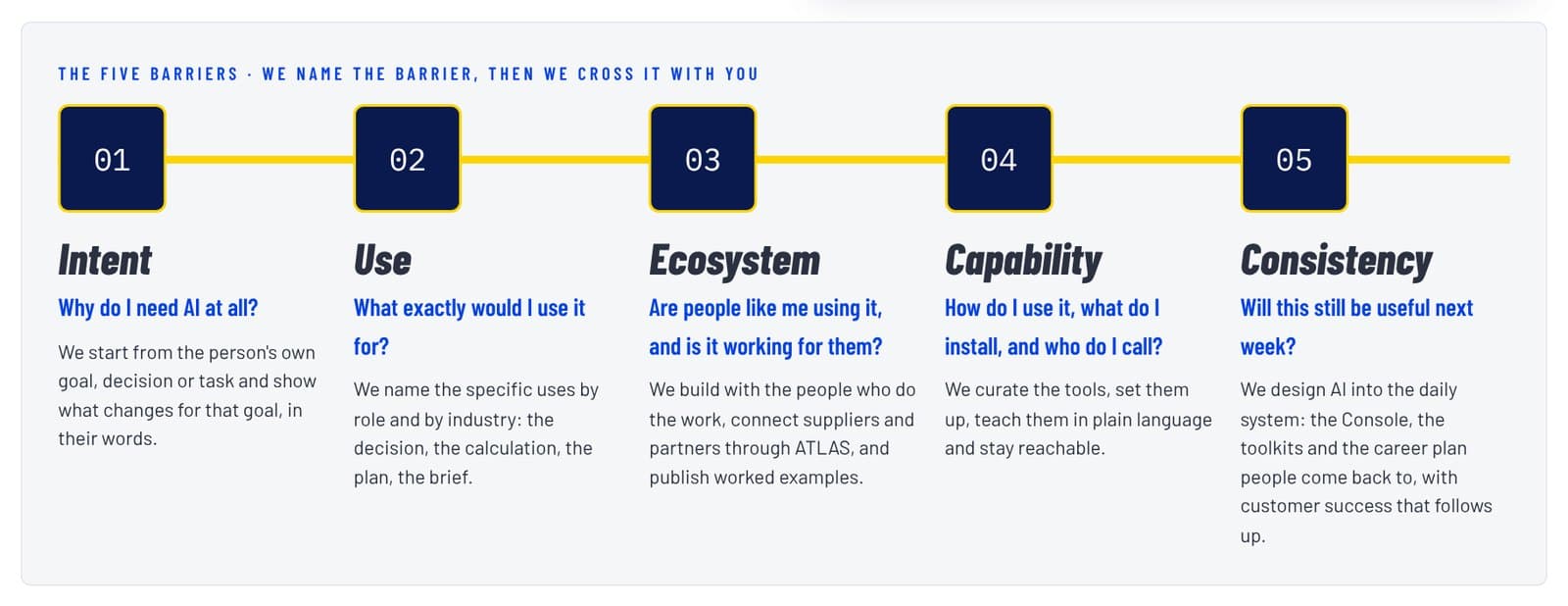
A quick way to see where you stand: read the five questions again and notice which one you can't answer yet.
- Can you say why AI matters for one of your goals?
- Can you name one specific first use?
- Do you know someone like you who uses it well?
- Do you have the tools set up and someone to call?
- Is it part of your week, every week?
The first "no" is your barrier. That is where to put your effort next.
Your next step
Pick the barrier you just found and take one step across it this week. If you lead a business, see how Watch Tower helps an organization cross all five. If you want practical tools for your job, try Forge. If you are thinking about your career, start with Beacon. Whichever fits, start with one real question in your work.
Frequently asked questions
What are the five barriers to using AI?
The five barriers to using AI are Intent, Use, Ecosystem, Capability and Consistency. Each is a question: why do I need AI, what exactly would I use it for, are people like me using it, how do I set it up and who do I call, and will it still be useful next week?
Why don't people use AI for real work?
Most people don't use AI for real work because they are stuck at one of five barriers, not because they lack interest or intelligence. Many have tried it once, saw examples that had nothing to do with their job, and found no first use, no peers, no one to call or no habit to bring them back.
How do I get started with AI as a beginner?
Get started with AI by writing down one decision you make often, one task that eats your time or one goal you keep pushing back. Then name one specific use for it, choose one or two tools, learn them on that real task, and put the AI step into a routine you already return to each week.
Which AI barrier should I work on first?
Work first on the earliest barrier you cannot get past. Ask in order: can you say why AI matters for a goal, name one first use, name someone like you who uses it well, reach someone when stuck, and use it every week? The first "no" is your barrier, because skipping ahead usually means everything fades.